Model Gateway
A model gateway centralizes access, routing, policy, reliability, and cost across model deployments, but model choice is part of application semantics rather than an invisible transport detail.
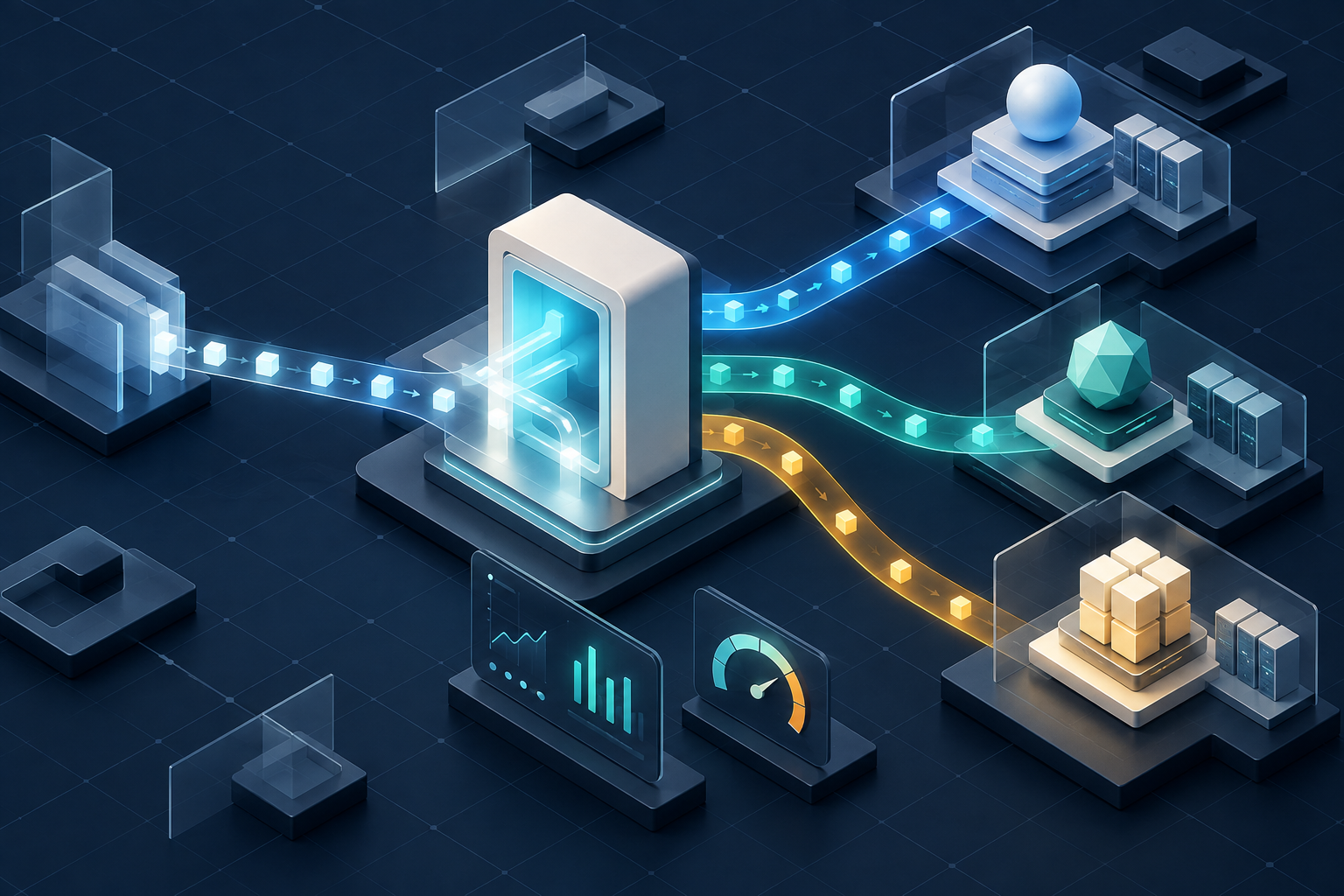
Model Gateway
Where Does the API Gateway Analogy Stop Helping?
The first model integration usually has one endpoint, one provider, and one configured model. It is simple enough to place the provider SDK inside the application and move on.
That simplicity rarely survives contact with a real workload.
Some requests need fast classification, others long-context synthesis. Some depend on a particular tool or structured-output contract, and some must stay within a regional data boundary. Then the preferred provider starts rate-limiting. Meanwhile, the finance team wants spend by product, the platform team wants one set of traces, and security wants provider credentials out of every application repository.
The application now has a choice. It can learn every provider’s API, pricing model, capability matrix, retry behavior, and regional deployment detail. Or it can put a shared boundary in front of those decisions.
That boundary is often called a model gateway.
A model gateway may provide a normalized API, provider adapters, authentication, quotas, rate limits, logging, caching, retries, fallbacks, cost tracking, or model routing. The name is useful because it points to a shared infrastructure boundary.
The name becomes misleading when it suggests that models are interchangeable services and that choosing one is merely a transport decision.
This is Post 16 in The Abstraction Shift: How Software Keeps Moving Up.
Why This Exists
Model providers expose overlapping but non-identical APIs. Even when several providers accept a similar chat request, they may differ in:
- supported input modalities;
- context limits and tokenization;
- structured-output behavior;
- tool-calling semantics;
- streaming events and partial-response behavior;
- reasoning or thinking controls;
- rate limits and concurrency limits;
- data-retention and regional-processing options;
- pricing for input, output, cached input, images, audio, or reasoning tokens;
- model versioning, aliases, and deprecation schedules.
An application that calls providers directly can manage these differences locally. That can be the right choice for a small system with one model and a clear owner. The cost rises when many teams integrate models independently.
Each application may create its own provider keys, retry code, cost meter, prompt transformations, logs, and fallback rules. One team may retry a timeout three times. Another may retry a streaming interruption without knowing whether the provider already generated a billable completion. A third may silently fall back from a tool-capable model to one that can only return text.
The organization then has a model problem and a platform problem at the same time.
A shared gateway can concentrate these cross-cutting concerns in one place:
- an authenticated entry point for applications and agents;
- the mapping from logical routes to provider deployments;
- quotas, budgets, rate limits, and concurrency;
- request, provider, model, token, cost, and latency data;
- provider-specific adapters and error mapping;
- allowed regions, retention policies, and credential boundaries;
- testing and revision of routing behavior.
Current implementations make different parts of this boundary explicit. LiteLLM describes a proxy that translates provider endpoints, normalizes responses, provides retries and fallbacks, and tracks spend and budgets. Cloudflare AI Gateway presents analytics, logging, caching, rate limiting, retries, and model fallback as control features around AI applications. AWS Bedrock offers intelligent prompt routing within selected model families, while Microsoft Foundry describes per-request model routing that considers request complexity and tool support. These are implementation examples, not one universal definition of the phrase.
The common pattern is an intermediate layer that decides how a model request enters the model estate and records what happened there.
What We Did Before
Reverse proxies, API gateways, client adapters, service discovery, retries, and circuit breakers already centralized access to remote dependencies. They normalized transport and controlled reliability, but they usually assumed that equivalent upstreams would preserve application semantics.
Model deployments are not interchangeable in that way. A gateway may standardize access while model choice, context transformation, fallback, and retry still change application behavior.
What Is a Model Gateway?
The phrase covers at least three related components. They can live in one service, or they can be separate.
A compatibility gateway
A compatibility gateway normalizes request and response shapes across provider APIs. It may expose an OpenAI-compatible or otherwise shared interface, translate message formats, map errors, and adapt provider-specific parameters.
This lowers the cost of trying providers and reduces repeated integration work. It does not guarantee behavioral equivalence. A parameter that is accepted by two providers may have different meaning. A parameter unsupported by one deployment may be dropped, emulated, or rejected. A response may be shaped the same while its semantic guarantees differ.
Compatibility should be treated as a declared subset of behavior. The more provider-specific features the gateway hides, the more important capability discovery and conformance tests become.
A traffic and policy gateway
A traffic gateway handles the concerns that appear around any expensive, shared, remote dependency:
- authentication and authorization for callers;
- virtual keys or workload identities;
- tenant and team quotas;
- rate and concurrency limits;
- timeouts, retries, and circuit breakers;
- request size and token limits;
- redaction and retention controls;
- caching where the request and data policy permit it;
- structured logs, metrics, traces, and cost attribution.
These concerns are familiar infrastructure. Model traffic makes them more visible because the resource is priced by tokens and behavior can be variable across calls.
A model routing control plane
A routing control plane maps a logical route to one or more model deployments. It may route by static policy, task metadata, context size, region, capacity, cost, predicted quality, or a combination of those factors.
The router can be simple:
- use the small model for classification;
- use the capable model for a high-risk decision;
- use the regional deployment for a restricted tenant;
- use a fallback when the primary provider is unavailable.
It can also be adaptive. A model router may inspect the request and predict which eligible model is likely to provide an acceptable result. That can reduce cost or improve latency, but the routing decision becomes another model-mediated decision whose quality needs measurement.
The central distinction is this:
A gateway can abstract provider access. A routing control plane influences the application behavior that follows.
Treat those as different responsibilities even when one product provides both.
The Route Contract
A model gateway should not route from a naked string such as best-model. It needs a contract that says what the caller requires and what the gateway is allowed to optimize.
At minimum, the contract should make these dimensions visible:
- Purpose: what task the model is helping perform.
- Input shape: text, image, audio, documents, conversation, or mixed context.
- Required capabilities: tool calling, structured output, long context, vision, reasoning controls, or streaming.
- Output contract: schema, fields, citations, refusal states, uncertainty, or maximum size.
- Data boundary: tenant, region, retention, training-use, or sensitivity constraints.
- Operating envelope: latency, concurrency, token, and cost limits.
- Continuity: whether the request needs the same model family, session affinity, cache locality, or only a compatible response.
- Fallback rule: which failures justify retry, which routes are compatible, and when the system must stop.
- Evidence requirement: which evals, traces, and outcome signals establish that the route is working.
Some constraints are hard. If a model does not support the required tool contract or cannot process the data within the allowed boundary, it should be excluded rather than given a low score.
Other dimensions are preferences. Among eligible deployments, the gateway can trade quality, latency, cost, capacity, and continuity according to an explicit policy.
This is a useful ordering:
- remove deployments that cannot satisfy the contract;
- rank the remaining deployments by the operating policy;
- record the candidates and selected route;
- validate the result against the contract and downstream outcome.
Routing by cost before capability produces a request path that is cheap and invalid.
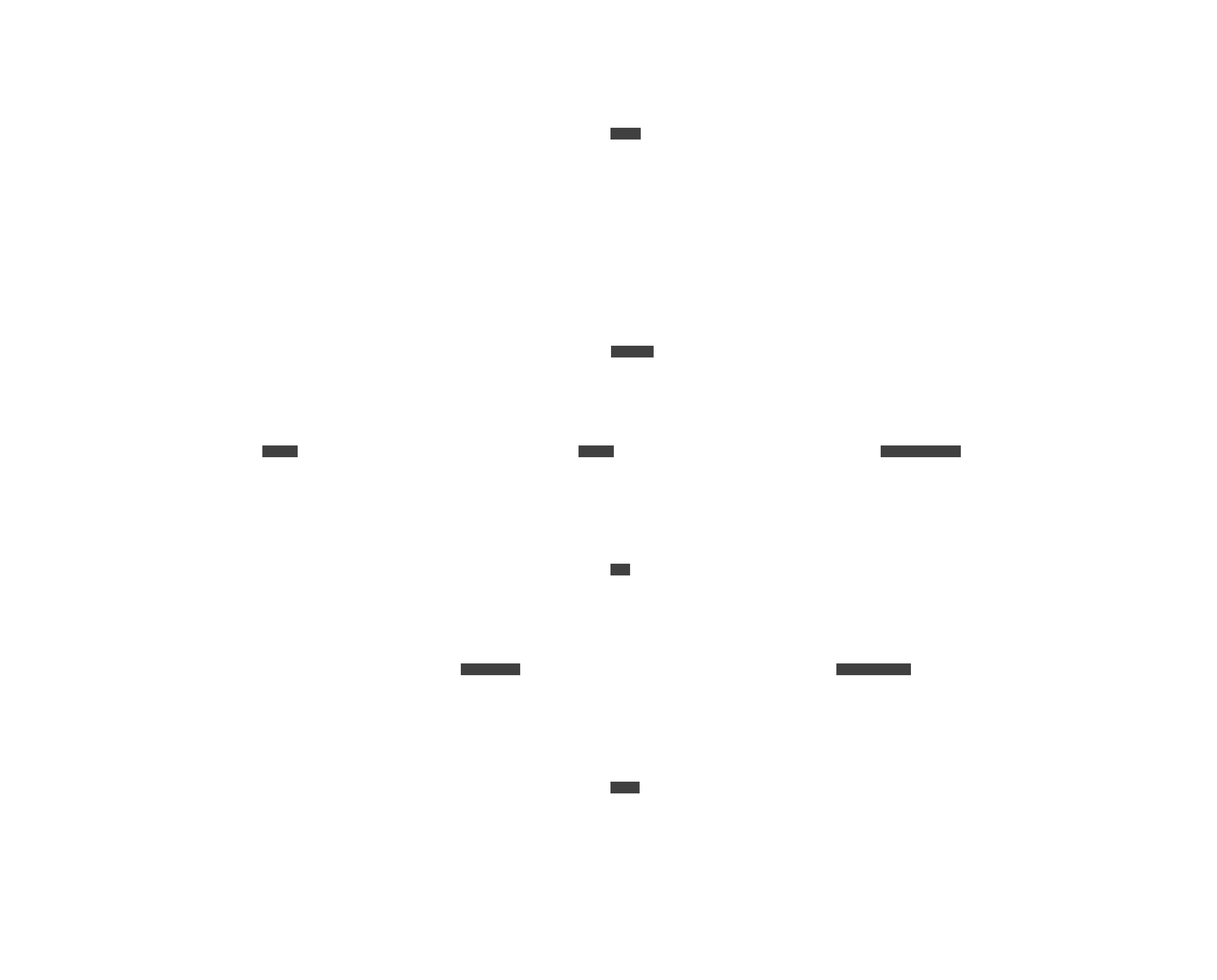
Safe routing removes deployments that cannot satisfy the contract before it optimizes among the ones that can.
Where the Analogy Breaks
A model deployment is not an equivalent upstream. Two deployments can accept the same request and differ in quality, refusal behavior, tool use, context handling, and cost.
That makes fallback something other than transparent failover. The route contract must say whether a weaker model is acceptable, whether the task should degrade, or whether the system must stop.
A provider response also falls short of a successful task. The application runtime still owns factual correctness, business policy, tool authority, side effects, and outcome verification.
Context is part of the program. Truncation, caching, summarization, message reordering, or tool rewriting can change what the model sees and must be traceable.
Routing is not authorization, and centralization is not automatic security. The gateway can enforce provider, tenant, data, and infrastructure policy; application and domain boundaries still enforce user authority and business rules.
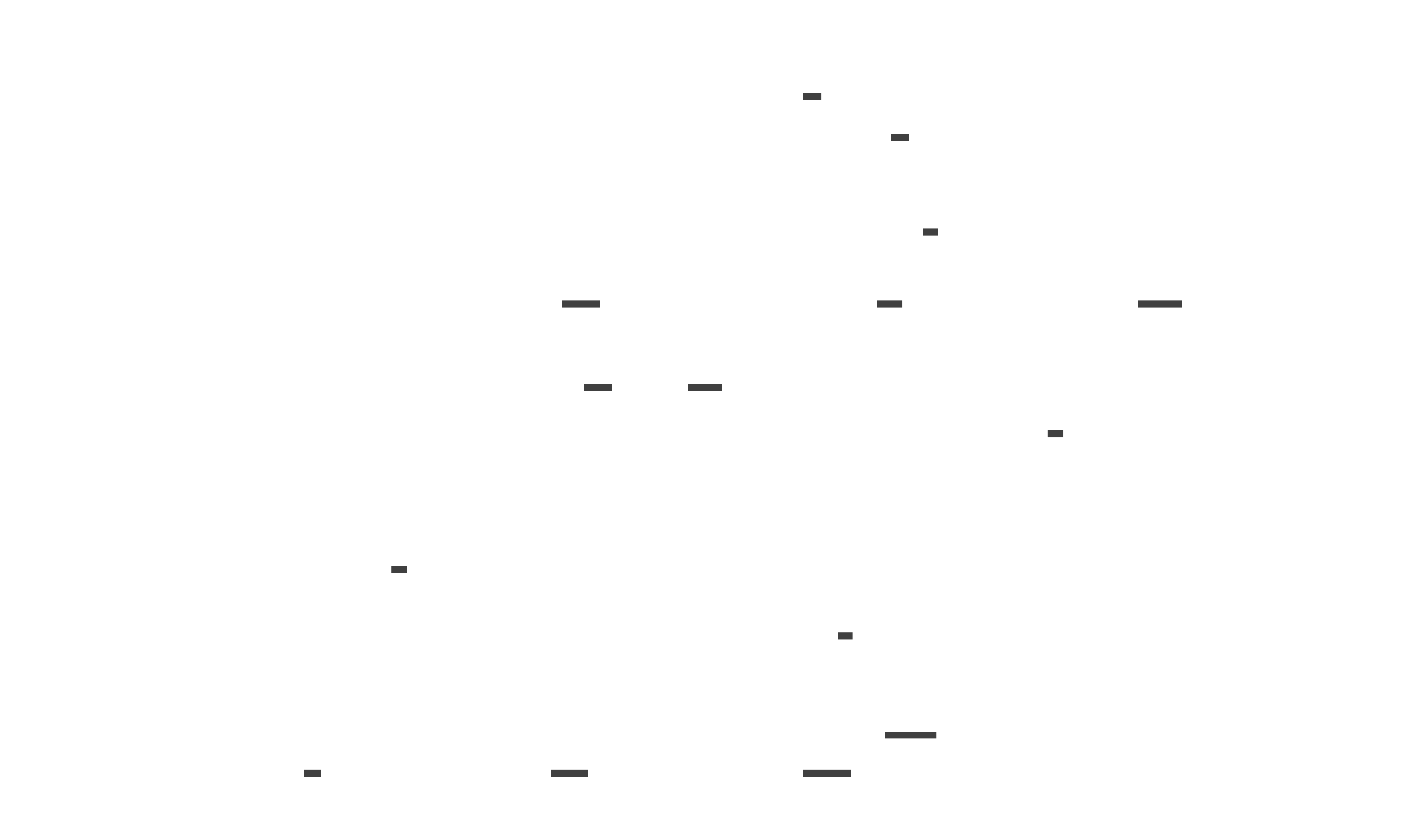
The gateway selects and invokes a model; the calling runtime owns meaning, authority, side effects, and outcomes.
Under the Hood
A practical gateway path is:
- authenticate the caller and resolve its route and data boundary;
- normalize the request without silently dropping behavior-changing fields;
- remove deployments that fail capability, region, context, retention, or tenant constraints;
- rank eligible deployments by measured quality, latency, capacity, cost, and continuity;
- execute with bounded retry, timeout, fallback, and streaming semantics;
- record the route, transformations, resource use, and provider result so runtime outcomes and evals can be joined to the decision.
The gateway can validate transport shape and declared output format. It should not label a response semantically correct merely because parsing succeeded.
A Concrete Example
Consider a support agent that receives this request:
Find the duplicate charge and refund it if the account and refund policy allow.
The agent runtime may need to retrieve customer and payment records, reason about duplicate evidence, ask for clarification, propose a refund, call a payment capability, and verify the resulting payment state.
The model gateway can support the path without owning the refund decision.
The runtime sends a logical route such as support-decision with a contract that requires structured output, tool calling, a particular context size, and a data region. It also includes the tool definitions and the context selected for this turn.
The gateway first removes deployments that cannot satisfy the tool or output contract, cannot process the tenant’s data in the allowed region, or cannot accept the context. It then ranks the remaining models by the route’s quality baseline, latency budget, current capacity, and cost policy.
It may choose a fast model for a simple classification turn and a more capable model for a multi-step decision. It may retry a transient provider error or choose a compatible fallback. The trace records the choice.
The runtime still has to:
- authenticate the user and establish account scope;
- treat retrieved records as evidence rather than instructions;
- validate the model’s proposed account, charge, amount, and reason;
- apply refund policy and approval requirements;
- authorize the payment capability;
- use idempotency and transaction controls;
- verify the payment system’s actual state;
- report the verified result to the user.
If the gateway falls back to a model that cannot reliably produce the required tool contract, the correct outcome is not a plausible refund explanation. It is a typed degradation, a clarification, an approval path, or a stop.
The gateway changes how the model is reached. It does not change who is allowed to refund an account.
Failure Modes
Invisible semantic downgrade
A deployment accepts the request but lacks a required capability. Record capability checks and reject silent downgrades.
Unsafe fallback or retry multiplication
Provider, SDK, gateway, and runtime retries can multiply cost or change behavior. Assign retry ownership and define fallback by task consequence.
Context loss
Transformation or truncation changes the model’s effective program. Make context changes explicit and traceable.
Data-boundary leak
A fallback processes restricted data in the wrong region or tenant scope. Treat data constraints as eligibility rules, not preferences.
Gateway observability gap
Infrastructure metrics do not show whether the user task succeeded. Join gateway traces to runtime traces, evaluations, and source-of-truth outcomes.
Centralized blast radius and lock-in
A gateway can concentrate credentials, sensitive data, policy, and provider dependence. Use least privilege, tenant isolation, auditability, and a documented contract with an exit path.
Sources
- A practical guide to building agents, OpenAI: describes model selection as a tradeoff among task complexity, latency, cost, and measured performance, and recommends establishing a capable-model baseline before optimizing.
- LiteLLM documentation: documents a proxy and SDK pattern for translating provider APIs, normalizing responses, retrying and falling back across deployments, and tracking spend and budgets.
- Cloudflare AI Gateway overview: documents analytics, logging, caching, rate limiting, request retries, model fallback, and multi-provider access as gateway capabilities.
- Understanding intelligent prompt routing, Amazon Bedrock: documents model-family routing based on predicted response quality, cost-oriented selection, fallback models, eligibility constraints, and current limitations of intelligent routing.
- Route model inference requests across AWS Regions, Amazon Bedrock: documents geographic and global cross-region routing, residency tradeoffs, quotas, and the need to observe the region where inference is processed.
- Use model router with Foundry agents, Microsoft Foundry: documents per-request model selection for agent workloads, complexity-aware routing, tool-aware eligibility, and route observability.
- The Tail at Scale, Google Research: provides the durable distributed-systems background for latency tails, hedging, and the operational cost of slow requests.
Subscribe
Get new posts by email
Enterprise architecture, AI systems, and platform strategy.